

Class 12 Physics - Electrostatics - Electric Charges
1. Electric Charge
Electric charge is a fundamental physical property of matter by virtue of which a body experiences and exerts electric forces—that is, it can attract or repel other charged bodies.
It is the basic cause of all electrical and electrostatic phenomena observed in nature.
All matter is made of atoms, which contain:
Protons → positively charged
Electrons → negatively charged
Neutrons → electrically neutral
A body becomes electrically charged when there is an imbalance between the number of electrons and protons:
Excess of electrons → negative charge
Deficiency of electrons → positive charge
Types of Electric Charge
Positive charge (+)
→ Due to loss of electronsNegative charge (−)
→ Due to gain of electrons
Unit and Measurement
SI unit: Coulomb (C)
1 Coulomb is defined as the amount of charge transferred by a current of 1 ampere in 1 second.
1 C = 1A X 1 Sec
2. Properties of Charge
i) Attraction and Repulsion
Like charges (positive–positive or negative–negative) repel each other, whereas unlike charges (positive–negative) attract each other.
ii) Quantisation of Charge
Electric charge exists in discrete units. The charge on a body is always an integral multiple of the elementary charge, given by
Q=ne
Q is the charge on the body, n is integer (positive or negative), e is the basic charge
iii) Conservation of Charge
The total electric charge of an isolated system remains constant. Charge is neither created nor destroyed; it is only transferred from one object to another.
Explanation:
In any physical process such as rubbing, contact, or induction, the total charge of an isolated system remains constant. Charges may redistribute among bodies, but the sum of charges before and after the process remains the same.
Example:
When a glass rod is rubbed with silk:
Glass rod becomes positively charged
Silk becomes negatively charged
However, the total charge of the system remains zero.
Importance:
This law is universal and is valid in all physical and chemical reactions.
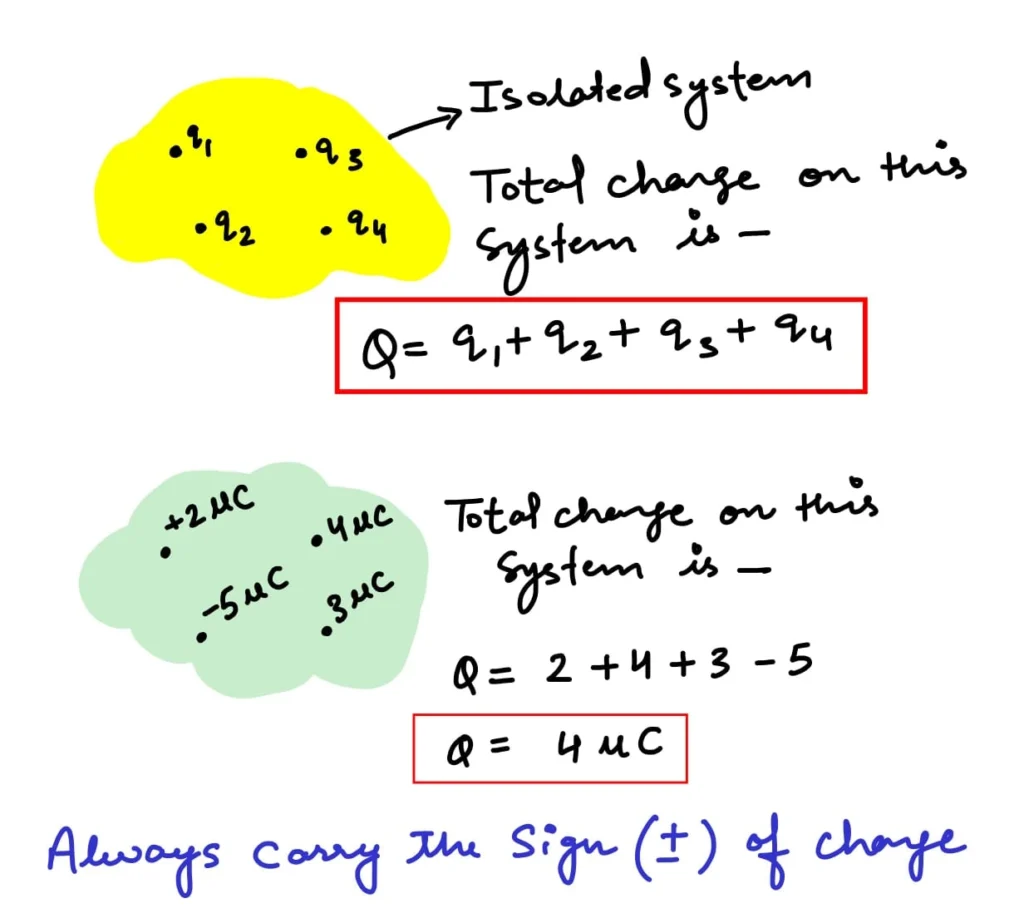
iv) Additivity of Charge
The net charge of a system is equal to the algebraic sum of all individual positive and negative charges present in the system.
v) Scalar Nature
Electric charge has magnitude only and no direction.
vi) Transferable
Electric charge can be transferred from one body to another, for example, through conduction.
vii) Association with Mass
Electric charge always exists along with mass, although mass can exist without charge.
viii) Invariant Quantity
The value of electric charge remains unchanged regardless of the speed of the body or the frame of reference.
ix) Radiation by Accelerated Charges
An accelerating electric charge emits electromagnetic radiation, thereby losing energy.
Download Free PDF Files
Download Free Physics All Formulas File
Important Maths Formulas for Competitive Exams
3. Charging
Charging is the process by which a neutral body acquires electric charge due to the transfer or redistribution of electrons.
Normally, an object is electrically neutral because it has equal numbers of protons and electrons. When electrons are added to or removed from an object, this balance is disturbed and the object becomes charged.
Gain of electrons → Negative charge
Loss of electrons → Positive charge
Key Points
Only electrons move during charging (protons remain fixed).
Charging does not create charge; it only transfers it.
Charging follows the law of conservation of charge.
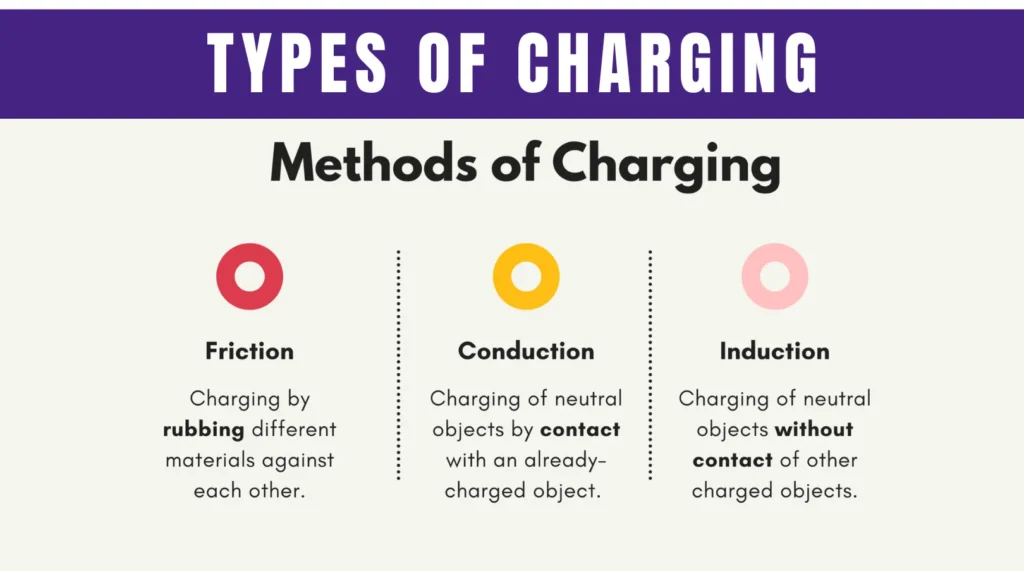
i) Charging by Friction (Rubbing)
Charging by friction occurs when two neutral objects are rubbed against each other, causing electrons to transfer from one body to the other.
Example
Glass rod rubbed with silk
Glass rod → positively charged
Silk → negatively charged
Important Points
Both bodies acquire equal and opposite charges
Follows law of conservation of charge
Common in insulators
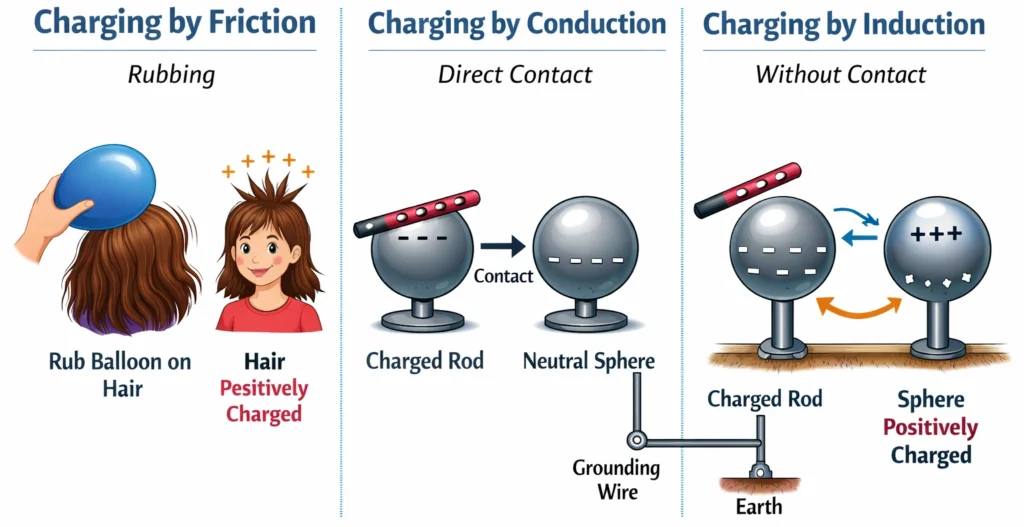
ii) Charging by Conduction (Contact)
Charging by conduction occurs when a charged body is brought into direct contact with a neutral body, allowing charge to flow.
Explanation
When a charged conductor touches a neutral conductor:
Electrons flow due to potential difference
Charge redistributes until equilibrium is reached.
The neutral body acquires same type of charge as the charged body.
iii) Charging by Induction (Without Contact)
Charging by induction is a process in which a neutral conductor is charged without touching the charged body.
Step-by-Step Explanation
Bring a charged body near a neutral conductor
Charges inside the conductor redistribute
Earth the conductor to allow excess charge to flow
Remove earthing, then remove the charged body
- The conductor gets a charge opposite to that of the inducing body.
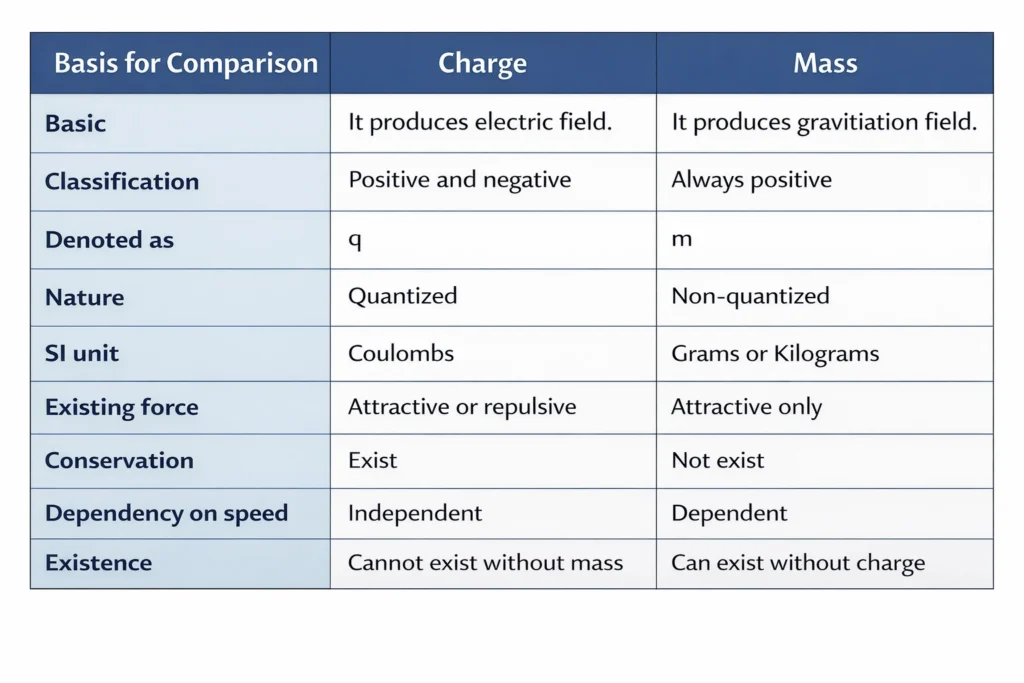
4. Electric Charge Vs Mass
5. Distribution of Charge on a Conductor and an Insulator
When a conductor is charged, it contains free electrons that can move easily throughout the material. Due to mutual repulsion between like charges, these free charges redistribute themselves until equilibrium is reached. As a result, all excess charge resides on the outer surface of the conductor, and no charge is found inside it. In electrostatic equilibrium, the electric field inside a conductor is zero, and the charge density on the surface is maximum at sharp edges and pointed regions.
Key points (Conductor):
Free electrons are present
Excess charge lies only on the outer surface
Electric field inside the conductor is zero
Charge density is highest at sharp points
In contrast, an insulator does not have free charge carriers. When an insulator is charged, electrons are not free to move, so the charge remains localized at the region where it is placed. There is no redistribution of charge over the entire surface, and an electric field can exist inside the insulator. Hence, the charge distribution in an insulator is generally non-uniform.
Key points (Insulator):
No free electrons
Charge remains localized
No surface redistribution
Electric field can exist inside
Next Topics :
Coulomb’s law, superposition principle
Electric field, field lines
Electric dipole, torque on dipole
Gauss theorem + applications (infinite wire, plane sheet, spherical shell)